Global network


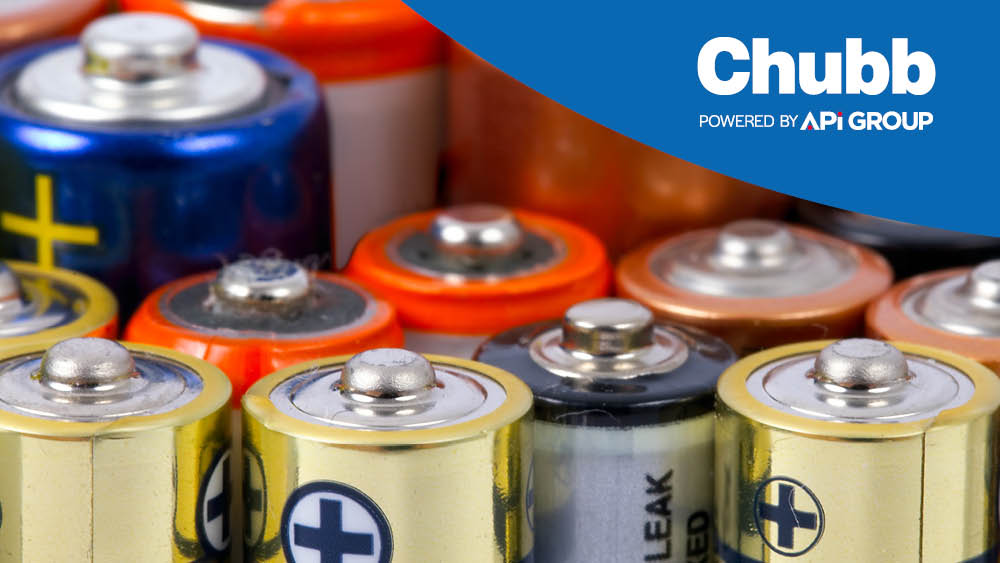
Lithium-Ion Battery Fire Safety: Understanding a Growing Workplace Risk
By Chubb | 22nd July 2026
By Chubb | 22nd July 2026
In a single meeting room with ten people, you could easily find forty or more lithium-powered devices in play at any one time, including laptops, phones, smartwatches, tablets, and wireless headsets. Multiply that across an office floor, a school, or a warehouse, and the scale of exposure becomes clear. They’re efficient, rechargeable, and everywhere, which is why lithium-ion battery risk deserves particular attention in fire safety planning.
The number of fires caused by lithium-ion batteries has also grown rapidly. According to analysis by insurer QBE, the number of lithium-ion battery fires attended by UK fire services increased 147% over a three-year period, with 1,760 lithium-ion battery fires in 2025 alone – roughly one every five hours*. Yet for many organisations, lithium-ion battery risk still isn’t formally addressed in fire risk assessments, leaving a significant gap in both prevention and emergency response.
Many organisations associate lithium-ion battery fires with electric vehicles or specialist industrial settings. In reality, the risk extends across almost every workplace environment, including:
If your business has a laptop charging wall, a stockroom full of handheld scanners, a fleet of electric delivery vehicles, charging pods or even just a bank of desks with phones and laptops charging throughout the day, your organisation is likely to have some level of exposure to lithium-ion battery risk. The scale may differ from one organisation to the next, but the underlying exposure is common to nearly every type of business.
It takes just one faulty charger, one damaged device, or one overworked extension lead in a busy area to create a serious incident.
Here is a selection just from this year:
These incidents illustrate how quickly a single battery failure can escalate into a major incident. They’re a timely reminder that lithium-ion battery fire safety isn’t a box-ticking exercise; it’s an active and growing threat that every business needs to plan for. Beyond the immediate fire risk, battery-related incidents can disrupt operations, damage critical assets and result in significant business interruption.
Public awareness of this risk is growing, and EV fire safety is becoming a bigger part of the national conversation. Incidents involving lithium-ion batteries, from e-bike fires to battery storage incidents in retail settings, are increasingly making headlines, putting pressure on businesses to demonstrate they’ve taken workplace fire safety for lithium-ion batteries seriously.
One of the most important things to understand about lithium-ion battery fires is that they don’t behave like conventional fires, and that has real implications for how you prepare and respond.
Traditional fires follow a broadly predictable pattern, but lithium-ion battery fires can defy that logic entirely. The key mechanism at play is thermal runaway, a chain reaction where a single failing battery cell overheats, then triggers neighbouring cells to do the same. This can happen with little or no warning. In some cases, there’s no visible smoke or smouldering beforehand at all; a device can go from fine to fully alight in moments.
Perhaps most concerning is reignition. A lithium-ion battery fire that appears to be extinguished can flare back up, sometimes repeatedly, as thermal runaway continues to spread through remaining cells. This makes containment and monitoring just as important as the initial response.
It’s also critical to know that CO₂ extinguishers (the standard choice in many workplaces) are not effective against lithium-ion battery fires and can make the situation worse. Standard fire-fighting methods and equipment simply weren’t designed for this type of fire. This is why a lithium-ion battery fire extinguisher, tested to recognised standards such as the Dutch NTA 3811, is essential. The Dutch NTA 3811 is currently the only credible benchmark for small lithium-ion battery fires up to 600Wh.
Understanding why lithium-ion battery fires start is just as important as understanding how they behave. In our experience, the risks generally fall into three categories:
Device issues
Charging issues
Storage issues
Individually, these might seem like minor oversights. Together, across a busy workplace with dozens or hundreds of devices in daily use, they represent a meaningful and largely preventable fire risk.
The good news is that many of the biggest risk factors are entirely within your control, and a proactive, structured approach can significantly reduce your exposure. On the charging side, this means using only official, manufacturer-approved chargers, replacing damaged cables immediately rather than waiting for them to fail, ensuring charging areas are well ventilated, switching off docking stations and chargers at the end of each day, and avoiding overnight charging wherever possible. Storage matters just as much: batteries and devices should be kept away from combustible materials, e-bikes and scooters stored outside main buildings where feasible, and charging areas kept tidy, uncluttered and free from stacked or clustered batteries.
Procurement decisions play a role too. Avoiding cheap, unverified imported devices and chargers, checking that CE marks include a valid notified body number, and purchasing only from reputable, established suppliers all help reduce risk before a device even enters the building. Finally, training and awareness tie everything together. Providing staff with lithium-extinguisher training, arranging fire warden training for key personnel, and running regular awareness sessions ensure that good practice becomes part of everyday culture, not just a one-off policy.
These fundamentals apply across virtually every workplace, regardless of size or sector, and form the foundation of good workplace fire safety for lithium batteries.
Practical solutions to support effective management of lithium-ion battery fire risk include:

Even with the best prevention measures in place, it’s essential that staff know how to respond if something does go wrong.
Call 999 immed
iately if a device is smoking, swelling, or hissing, if flames are visible, or if an EV, e-bike, or scooter is involved in a fire and never attempt to move or handle a burning device yourself.
Having the right equipment, procedures and training in place is crucial. Understanding the risks, implementing sensible charging and storage controls, adopting appropriate fire safety measures and ensuring staff are properly trained can significantly reduce the likelihood and impact of an incident.
As lithium-ion ba
ttery use continues to grow, proactive fire safety planning will become an essential part of protecting people, property and business continuity.
Managing Lithium-Ion Battery Risk with Chubb
Visit: Fire Extinguishers – Chubb Fire & Security : UK – EN

Oops! We could not locate your form.
 Privacy Policy and Terms of Service apply.
A global organisation Chubb’s global footprint, and local expertise is reflected in its 12,000+ team, working from 200+ offices across 17 countries. Get in touch with our regional offices
We deliver our services through a global network of over 12,000 highly specialised and fully compliant staff, 200+ branches and more than 20+ monitoring centres worldwide, providing a customised local service supported by expert teams, 24/7, 365 days a year.